
Thought Leadership Articles
Published 22 September 2025

The Secret is out: ‘Ability to Execute’ is in
Effective decision-making is the cornerstone of a successful organisation. In my years of working with organisations, I’ve seen time and time again that advisory boards give leaders one thing above all: confidence.
The research agrees. The State of the Market Report (2025-2027) found that the key benefit of high-quality advisory boards is confidence in decision-making. For me, it raises an important question: is there a correlation between increased confidence, better decisions and ultimately better outcomes?
Confidence in decision-making can be viewed from two different perspectives.
- Self-Confidence in Decisions
The individual being confident in the decisions they make. This is when, after consideration of factors, the individual arrives at a confident internal decision. - Confidence Placed in the Decision-Maker
This is when others assess the decision-maker through a lens of fairness, transparency and impact.
Today, a growth factor in the adoption of best practice advisory boards is being driven by the second perspective of “confidence in the decision maker”.
Great Expectations
In an era of heightened accountability, leaders must navigate complex expectations whilst maintaining credibility and strategic clarity. The pressure can come from multiple directions: their own expectations, the standards set by internal stakeholders and the perceptions of external stakeholders. Trust is ultimately earned through the demonstrated integrity of the decision-making process and the tangible outcomes that follow.
Applying Advisory Boards to Drive Informed Decisions
“Being well informed is a hallmark of a trusted Leader” has become a prominent quote from the State of the Market Report (2025 – 2027) as a key megatrend driving advisory board activity. It explores the subtle yet important shift from the decision maker (subjective and undefendable) to focusing on the informed decision-making process (objective and defendable).
As advisory boards are not a decision-making function, they have an important influencing role in “informing” decision makers at a board, executive or project level. There needs to be accountability in the way they work, with a strong business case, quality protocols, and outputs.
Leader’s Guide to the Confidence Equation
When using advisory boards, what do leaders need to do to demonstrate a quality decision making process to earn trust and confidence? This is what we call the Confidence Equation.
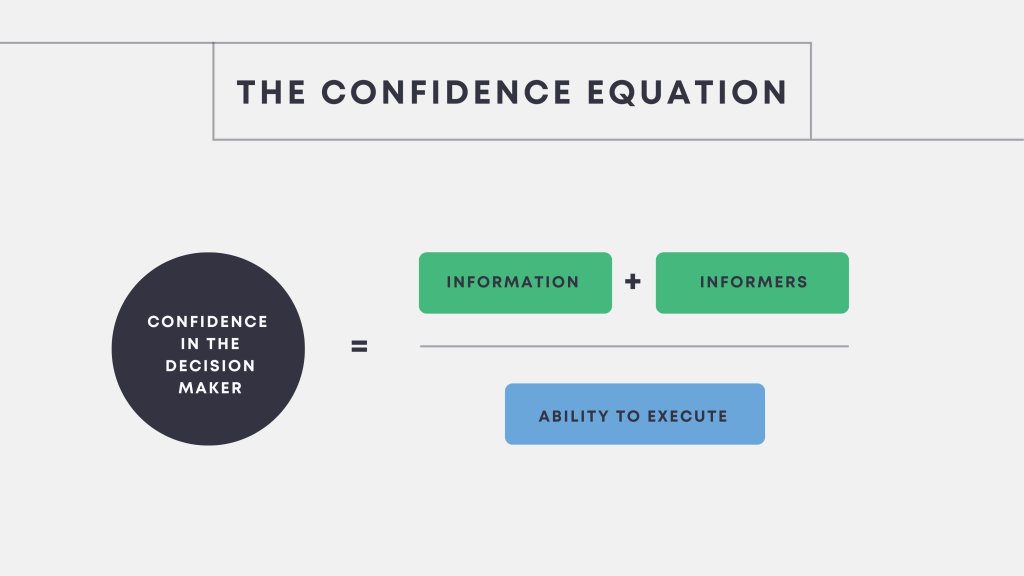
The Confidence Equation: ‘Information’
The Challenge: Faced with a deluge of information sources, leaders can easily become overwhelmed by the sheer volume of data and unfiltered opinions leading to decision paralysis.
The Opportunity: By carefully navigating the volume of data, identifying source reliability and leveraging emerging technologies — including the use of AI — leaders can identify trustworthy insights and gaps in truth. Preparation of information for advisory boards targets and focuses conversations that matter.
The Confidence Equation: ‘Informers’
The Challenge: In an environment where there is no shortage of ideas and opinions, time-poor executives struggle to have the bandwidth to access advice and create effective meeting structures within their existing decision-making models.
The Opportunity: Accessing the right combination of advisors at the right time. Leaders can de-risk conversations through independence, enabling careful preparation and well-considered debates that incorporate diverse high-quality perspectives.
The Confidence Equation: ‘Ability to Execute’
The Challenge: Competing priorities, excessive reporting, and overly full agendas often lead meeting structures to fail. Those sponsoring or managing the meeting often leave with more questions and ambiguous outcomes.
The Opportunity: The ‘ability to execute’ is one of the key opportunities for advisory board professionals today. As seen in the Confidence Equation, it underscores everything. Well prepared and managed meetings allocate more time in the agenda to focus on the organisation’s ability to execute. This outcome-focussed approach prioritises impact through practical and agile discussions.
The Science of Facilitation
Agenda design and a focus on the organisation’s ability to execute are both crucial in advisory board effectiveness and how leaders are being informed. Chairs, sponsors and secretariats can adopt scientific approaches to drive the outcomes they are seeking as well as maintain alignment.
As we approach 10 million advisory board professionals globally, I encourage the sector — including Chairs, Advisors, Sponsors and Secretariats — not to “wing it”. With so much at stake, building trust in both the process and the people involved is critical. Done well, building confidence, capability, and capacity creates better decisions and ultimately better outcomes for all.
Building confidence starts with building your advisory board on the right foundations. Our Advisory+ service supports organisations at every stage of the process, from board establishment & structure to board recruitment and board reviews — get in touch with our Advisory+ team here.
Honing your facilitation skills takes dedicated learning and practice. Join us for our Advanced Facilitation Skills Program in Dubai on November 21 — learn more here.


More Thought Leadership Articles

Thought Leadership Articles
Why professional services providers can be a natural fit for advisory boards

Thought Leadership Articles
How to create an advisory board for your business
Businesses will generally start an advisory board at a make-or-break point, especially if they are asking, “what is our focus?” or “what’s next?”