
Wrap-up: Advisor Rates & Engagement Briefing
Latest News
Published 26 May 2026
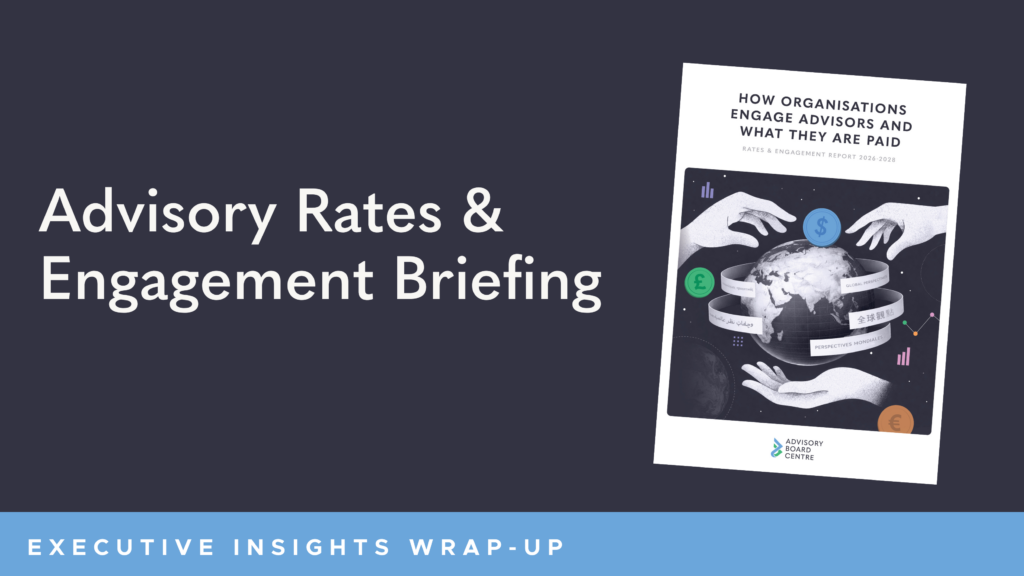
Last week’s Executive Insights webinar marked the release of the Advisory Board Centre’s most comprehensive study to date: the Advisor Rates and Engagement Report 2026-2028.
Drawing on three years of research, spanning 76 global focus groups, 1,200 surveys and more than 50 case studies, the report offers a rare, data-rich view of a sector that has decisively matured.
The numbers alone tell a story. What was once a niche practice has expanded into a global professional ecosystem. Advisory board professionals have grown from just over one million in 2019 to nearly ten million in 2025, with further expansion all but certain. Activity is no longer concentrated in a handful of markets: it is diffusing, normalising and embedding itself across geographies, sectors and governance models.
Beneath that growth lies something more consequential: a decisive shift in how organisations seek, deploy and remunerate external advice.
There’s a decisive shift in how organisations seek, deploy and remunerate external advice.
Here are the key insights from the briefing session:
1. Rising demand for advice as a hedge against uncertainty
While growth remains the principal motivation for establishing advisory boards, the sharper rise is the demand for guidance through uncertainty.
Organisations are turning to advisory boards to interpret volatility, complexity and systemic change. In other words, advice is no longer a luxury. It is risk management.
2. A broader, flatter market
Advisory boards are increasingly sector‑agnostic. From education to technology, manufacturing to financial services, and from non‑profits to family enterprises and beyond, there are no longer clear sectoral outliers. Instead, advisory boards have become a broadly adopted tool, used by organisations across the spectrum.
3. Advisor rates are beginning to converge
After years of opacity, rates are beginning to converge, which is a hallmark of sector maturity. The most common half-day rate now sits between $1,000 and $2,500. Outliers do remain, chiefly where scarce expertise is in play (download our Executive Summary for more details). Retainer models, particularly for chairs, have emerged as the dominant form of engagement, reflecting longer and deeper commitments.
When it comes to receiving equity as remuneration, it remains contentious. Opinions remain divided on whether “skin in the game” sharpens or distorts advice.
4. The shift to sustained engagement
Portfolio professionals, who represent the majority of the sector, are holding fewer roles on average. The shift from five or six engagements to two to five suggests something important: work is becoming more embedded and more sustained.
5. The rise of the trusted advisor
Perhaps the most significant structural shift is the emergence of the “one trusted advisor”. Organisations are increasingly appointing a strategic advisor, often functioning as a chair, to orchestrate a broader advisory ecosystem. Advisory boards themselves are becoming modular, project-based and fluid.
6. Independence is under pressure
Independence, long the defining virtue of advisory boards, is being tested by closer relationships and blended roles. The report surfaces an unresolved debate around conflicts of interest, particularly where mentoring, consulting and advisory roles intersect. Advisory Board Centre Founding Director, Louise Broekman, reflected on the ethics of blended roles in this recent thought leadership piece.
7. New world, new skills in demand
The demand profile for advisory is shifting. Marketing and sales expertise are now among the most sought-after capabilities, reflecting pressure on growth engines. Alongside this, there is rising demand for human capital expertise in an ever-changing technological world. Organisations are grappling with workforce transformation, culture and the implications of this change.
The premium is increasingly on those who can integrate tech into strategy, people and execution.
That’s a wrap!
Keen to dive deeper into advisory rates and engagement? The Executive Summary is available to the public here.
Advisory Board Centre Members can access the full report at no cost via Advisory Board World.


More Latest News

Latest News
Advisory in AI Adoption