
Advisor Insights
Diversification Strategy for Sustainable Growth in the Health & Social Services Sector
Advisory Board Business Case with Ari Magalhaes
Advisor Insights
Published 23 March 2026
A recent survey by McKinsey of 10,000 senior executives around the world found that the top concerns on directors’ minds are AI and geopolitical instability, among a myriad of other challenges.
Advisory boards have ample opportunity to support organisations as they face the onslaught of pressures, but maintaining ethical standards and upholding best practice advisory principles must not be overlooked in the race to capitalise on opportunities.
How do advisory boards maintain their standards?
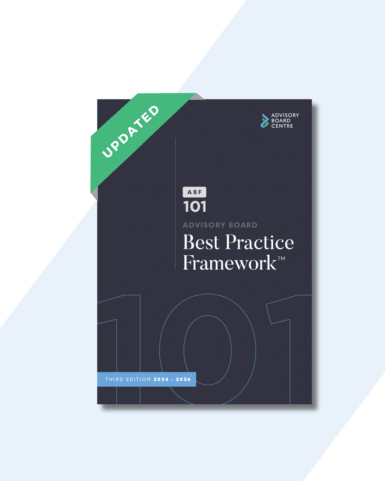
Under the wing of the Advisory Board Centre’s Global Research Council, the Best Practice & Ethics Advisory Board has been charged with independently assessing emerging trends and provides feedback on the ABF101 Advisory Board Best Practice Framework™ and the Code of Ethics guidelines. The board, comprising nine committee members from across the globe, meets quarterly to address a full agenda.
What exactly happens in the boardroom? We spoke to Chair, Jane Beaumont, to gain insights from the first meeting of 2026.
Q: Walk us through what happens at quarterly Best Practice and Ethics Advisory Board meetings?
A: The Board brings together very capable minds, and meaningful contribution from all members is critical. Meetings are structured and focused to ensure everyone is heard. We are not there to nod heads and gain consensus – that is not the purpose. We are looking for diverse views and experiences. It’s a tight agenda, 90 minutes of absolute go-go-go! As it is a Thought Leadership agenda, key insights and takeaways are captured, and many of these points may go on to inform broader discussions, including matters that flow to the Global Research Council.
Q: How do the outcomes of the meetings affect the advisory community?
A: Through the research. For example, every two years we review the ABF101: Advisory Board Best Practice Framework™. We look at absolutely everything, because the advisory space has changed so much, and will continue to do so. The sector is rapidly evolving. Updates to best practice principles directly influence how Advisory Board Professionals operate in their day-to-day engagement. The principles really need to be relevant for today’s world. It’s an iterative process.
Q: What do you see as the key emerging trends, risks, or ethical considerations that are particularly important for the sector right now?
A: The significant forces at play globally, namely geopolitics and the rise of AI, are of course creating all sorts of stresses and strains. McKinsey’s recent survey confirms what was also found in the State of the Market Report, that businesses are feeling the pressure, spanning organisational structures, governance, people, and so much more. In 2026 and beyond, the key question will be how advisory boards are engaged with, and respond to, this evolving context.
Then there’s the ethical challenges of the blended role of advisors. Relationships and trust are important, and for that reason, advisors tend to be staying in longer and deeper engagements. We must think critically about blended roles, it’s really important, because as advisors we must ensure that independence is maintained.
Q: What best practices were shared or reinforced during the meeting that other advisory board professionals could learn from?
A: As Chair, I start the meeting by sharing our focus and how the advisory board meetings are structured, how they run, and that my commitment to expert facilitation. As an effective advisory board, we are able to draw out diverse viewpoints from our members. It’s essential for fostering rigorous debate on principles and ethics for the sector, and for translating these into Best Practice and Ethics frameworks. This lies at the heart of the Best Practice and Ethics Advisory Board’s purpose.
Q: On a personal note, what are you most looking forward to in the role of Chair on the best practice & ethics board in 2026?
A: I want to enhance my Chair capabilities! That’s really important to me. I absorb a lot, I read a lot, I’m always digging into things to find out more. I think it’s really important that we continue to grow and learn.
Thank you, Jane!
You can learn more about the Best Practice & Ethics Advisory Board and its committee members here
Advisory engagement


Advisory Board Business Case with Ari Magalhaes

Advisory Board Business Case with Louis Gagnon

Advisory Board Business Case with Annalie Killian